
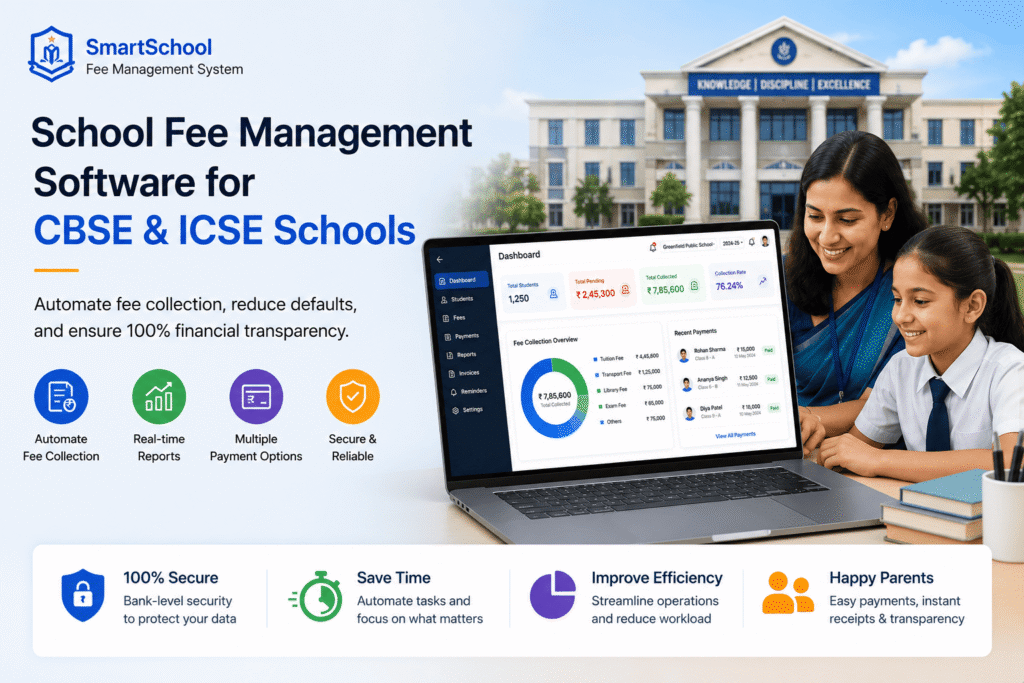
Fee management software is a digital system that automates fee collection, invoicing, and financial reporting for schools, allowing them to track payments seamlessly. It replaces manual fee registers, paper receipts, and door-to-door reminders with one online dashboard for various fee payments. For a school handling 500 to 5,000 students, this single change saves dozens of hours every month and removes the most common source of accounting errors: manual data entry in fee categories.
This guide covers what this kind of system does, why schools need it now, the features that separate a strong system from a weak one, and how to choose the right software for your school.
What Is Fee Management Software?
A fee management system is a software solution that automates school fee collection, payment tracking, reminders, and receipt generation from a single platform.
A fee management system is a module inside a school ERP that handles every step of fee collection. Specifically, it tracks how much each student owes, sends reminders before due dates, accepts online payments, and generates fee receipts automatically.
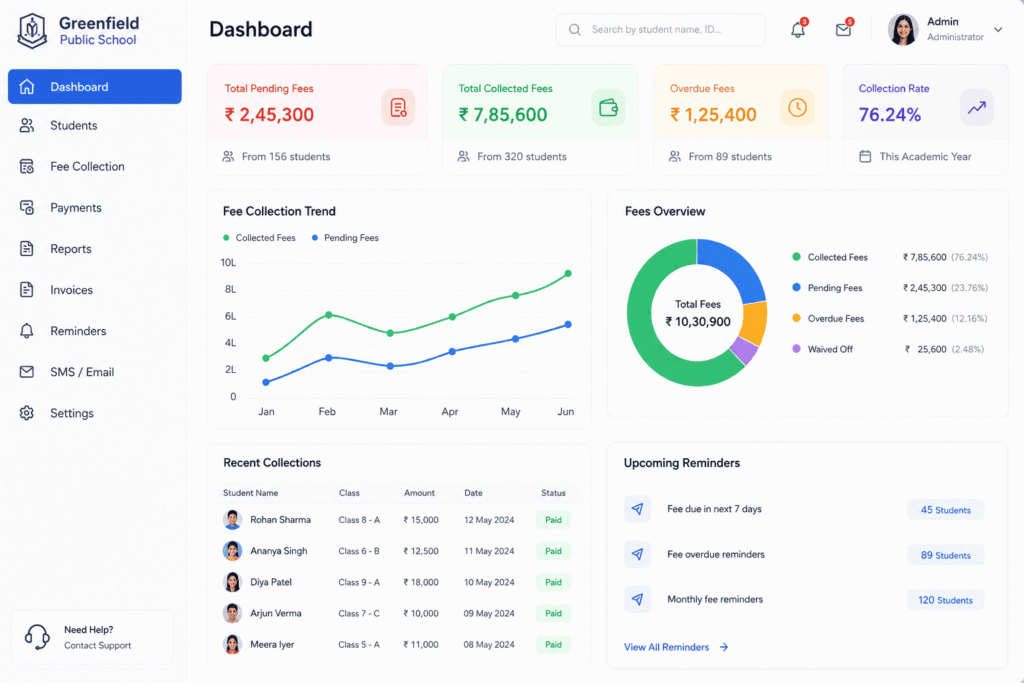
As a result, a school using this kind of system no longer needs separate paper registers for each class. Instead, one dashboard shows total collection, pending dues, various fee heads, and defaulters across the entire school in real time. Consequently, accountants spend less time on manual entry and more time on actual financial planning, budgeting, and reporting to the management committee.
In addition, most systems store a full payment history per student, so parents and administrators can look up any past transaction without digging through old files.
Why Schools Need Fee Management Software in 2026
Three forces, in particular, are pushing Indian schools toward digital fee collection this year.
Parent expectations have changed. For instance, most parents already pay utility bills, school transport charges, and online shopping through UPI, making fee payments easier. As a result, a school still collecting fees by cash or check feels outdated and creates unnecessary friction for working parents who cannot visit the school office during business hours.
NEP 2020 pushes educational institutions toward digital infrastructure to manage student fees more effectively. Specifically, the National Education Policy 2020 encourages schools to modernize administration, not just classroom teaching, by utilizing fee collection software. In fact, fee management is one of the simplest places for a school to start its digital transition, since it directly affects cash flow and helps track payments.
Manual fee collection does not scale. For example, a school with 2,000 students cannot accurately track partial payments, late fees, scholarships, and refunds on paper. Moreover, small errors compound every term, and reconciling accounts at year-end becomes a multi-week task involving several staff members instead of a few clicks.
Key Features of a Good Fee Management System
Of course, not every fee management system software offers the same depth in managing fee transactions for different types of fees. Therefore, schools should check for these core capabilities before signing a contract.
Automated Fee Reminders and Receipts
Ideally, the software should send SMS, email, or WhatsApp reminders automatically before a due date, with a follow-up reminder if payment is still pending. Then, after payment, it should generate a digital receipt instantly, with no manual step from the accounts office, enhancing the online fee collection process.
Multiple Online Payment Options
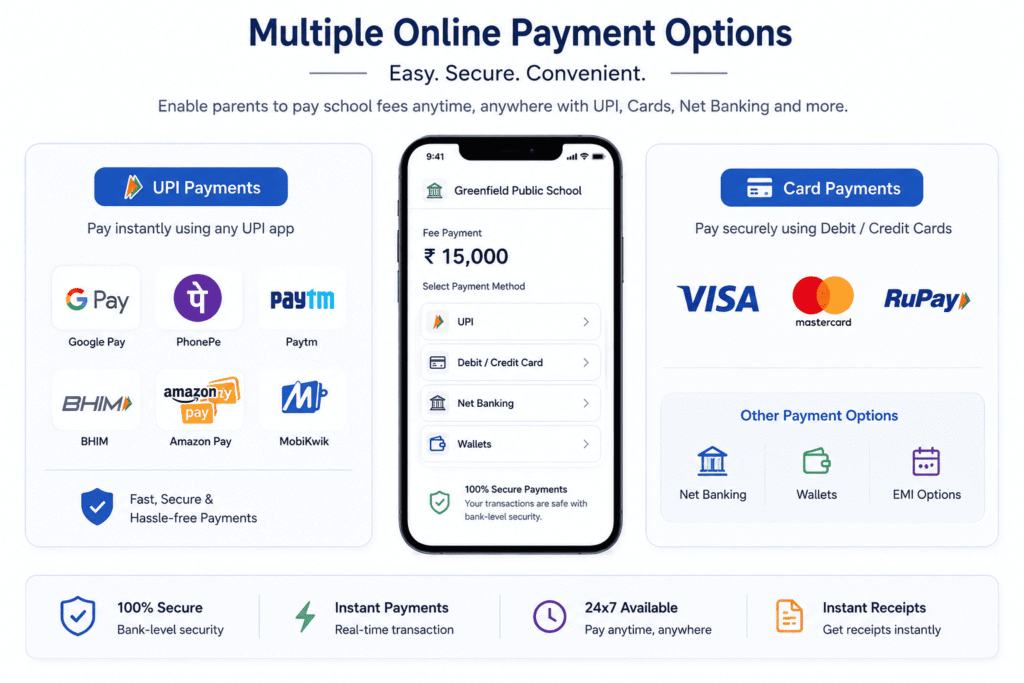
UPI is now India’s most widely used digital payment method for student fee transactions, including library fees, so naturally, any serious fee management system must support it alongside debit cards, credit cards, and net banking. In other words, parents should be able to complete a tuition fee payment from a phone in under two minutes.
Real-Time Fee Reports for Accountants
First, accountants need live dashboards showing total fees collected, pending dues by class or section, and daily transaction logs. In addition, this data should export cleanly to Excel for audits, without manual recalculation by staff, ensuring a smooth fee collection process.
Custom Fee Structures and Installments
After all, schools rarely charge one flat fee for every student. That is why a strong fee management system supports class-wise fee structures, optional add-ons such as transport or hostel charges, sibling discounts, and installment plans that split annual fees into manageable installments.
Fee Management System vs Manual Fee Collection
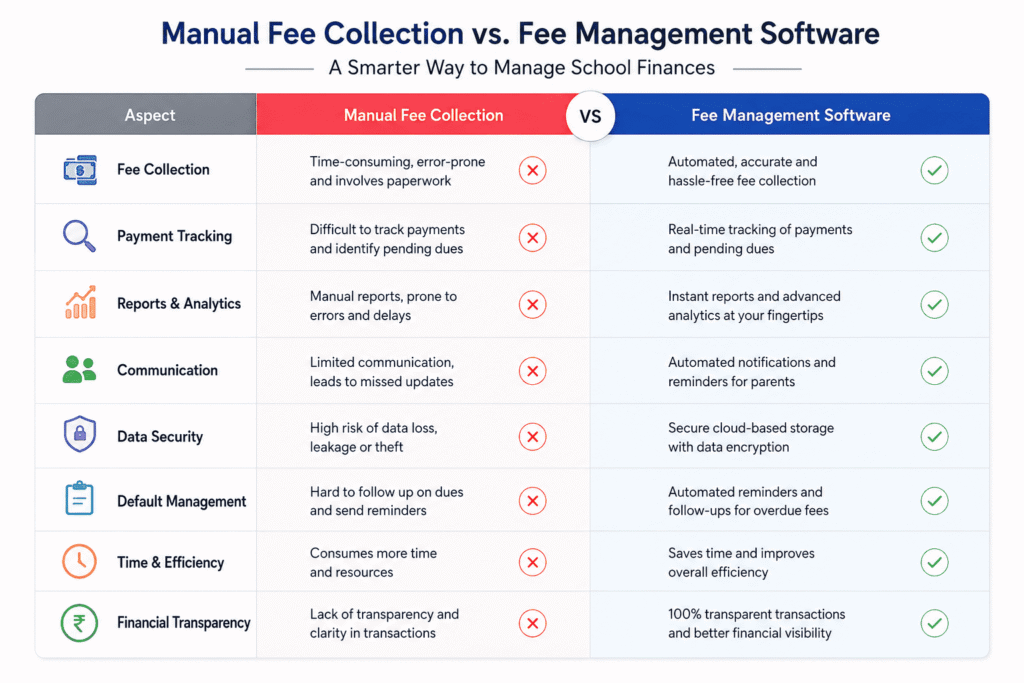
For clarity, the table below compares manual fee collection with dedicated fees management system software across the factors that matter most to schools.
| Factor | Manual Collection | Fee Management Software |
|---|---|---|
| Payment modes | Cash and check-only options limit the fee collection process. | UPI, cards, net banking, wallets |
| Reminders | Phone calls, printed notices | Automated SMS, email, WhatsApp |
| Receipt generation is crucial for maintaining accurate records of student fee transactions. | Handwritten or manually printed fee receipts are becoming obsolete. | Instant digital receipt for every fee transaction. |
| Defaulter tracking | Manual register cross-check is inefficient compared to automated fee collection software that helps educational institutions manage student fees effectively. | Real-time dashboard |
| Reconciliation time | Days to weeks can be saved in fee calculations with the right software. | Minutes can be saved on generating reports related to fee management. |
| Error rate | High, dependent on manual entry | Low, system-calculated |
Overall, this comparison is why most CBSE, ICSE, and state board schools across India are replacing manual fee registers with software-based collection, especially in Tier 2 and Tier 3 cities where digital adoption among parents has grown sharply.
Benefits of an Online Fee Management System
School Administrators
First of all, administrators get one consolidated view of fee collection across every class and section. As a result, they can spot delayed payments early, plan budgets using accurate live numbers, and present clean reports to the management committee without compiling spreadsheets manually.
For Parents
Likewise, parents can pay fees from home, at any time, through their preferred payment method, making it easier to manage student fees. Afterward, they receive instant confirmation and a downloadable receipt, with no need to visit the school office or wait in a queue during admission or term-start rushes.
For Accountants
Similarly, accountants save several hours each month that used to go into manual entry and register maintenance with the help of online fee collection. Consequently, year-end audits move faster because every transaction carries an automatic timestamp and payment reference, ready for inspection.
How to Choose the Right Fee Management System
Before signing up, schools evaluating this kind of fee collection software should check the following points:
- Payment gateway support: Confirm the software supports UPI and major cards for secure online fee payments, ensuring convenience for students and parents.
- Data security: Ask whether parent and student financial data is encrypted and stored on secure servers and whether the vendor follows standard payment-industry compliance for online fee collection.
- Ease of use for non-technical staff: Accountants and clerks should be able to use the system with minimal training.
- Integration with the rest of the school ERP: Fee data should connect with admissions, attendance, and report cards, instead of sitting in an isolated tool.
- Support and onboarding: Finally, confirm whether the vendor offers setup assistance and ongoing customer support in your region and language.
Once a shortlist is ready, schools exploring this decision can compare school ERP features before requesting a demo or view current pricing plans to understand likely costs for their school size.
FAQs About Fee Management Software
What is fee management software used for?
In short, fee management software is used to collect, track, and report school fees digitally. Specifically, it replaces manual registers with automated invoicing, online payments, and real-time defaulter tracking, all from a single dashboard to manage student fees efficiently.
Is it safe for parents to pay school fees online through this kind of fee collection software?
Yes, it is essential to have a robust fee management system in place. Specifically, reputable software processes payments through PCI-DSS-compliant gateways and does not store card details on the school’s own servers. In fact, parents pay through the same secure infrastructure used by banks and major e-commerce platforms.
How much does a fee management system cost for a school?
Overall, cost depends on the number of students, the modules required, and the level of support included. Therefore, schools should request a quote based on their exact student strength rather than relying on a generic published price, as fee calculations for types of fee vary by vendor and feature set.
Can this kind of system send automatic fee reminders?
Yes. Typically, most fee management systems send SMS, email, or WhatsApp reminders a set number of days before the due date, followed by additional reminders if the due date passes without payment.
Does the fees management system software support UPI payments?
Yes. In fact, UPI is supported by virtually all modern school fees management software sold in India, alongside debit cards, credit cards, and net banking, making it the most-used payment mode among parents today.
Final Thoughts
Overall, fee management software has moved from a “nice to have” to a basic requirement for Indian schools. Specifically, it reduces manual work, gives administrators real-time visibility into collections, and meets the payment expectations of today’s parents. Meanwhile, schools still relying on registers and cash collection are likely losing both time and accuracy every single term, and that gap tends to widen as student strength grows.
Therefore, schools ready to move away from manual fee collection can adopt school fees management software. Book a free demo to see how a complete fee management system works inside a school ERP.